

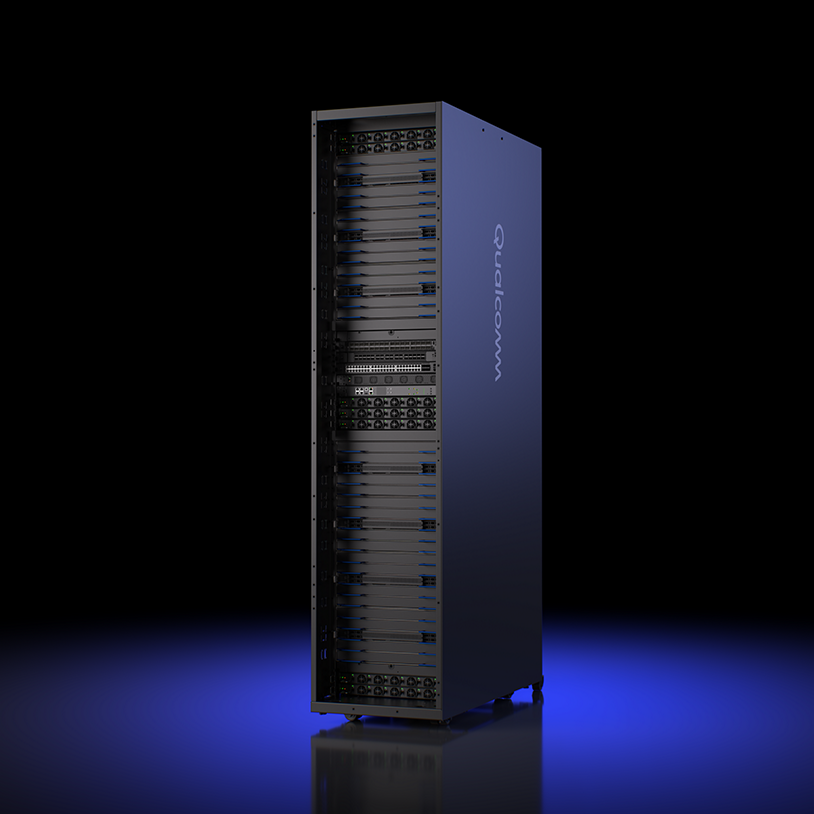
Qualcomm has announced two new data-center AI inference platforms — the AI200 and AI250 — marking a major step in its push toward high-performance, energy-efficient generative AI infrastructure. Unveiled in San Diego, the new solutions are designed to deliver powerful rack-scale performance while keeping total cost of ownership low for enterprises deploying large AI models.
The Qualcomm AI200 is built as a rack-level inference system optimized for large language and multimodal models. It supports 768 GB of LPDDR memory per card, giving data centers significantly higher memory capacity at lower costs. The platform focuses on efficiency, scalability and the ability to handle demanding inference workloads across different industries.
The more advanced Qualcomm AI250 introduces a new memory architecture based on near-memory computing, which enables more than 10 times higher effective memory bandwidth and substantially lower power consumption. This design helps companies run disaggregated inference workloads more efficiently, maximizing hardware usage while meeting performance and budget demands.
Both new rack systems include direct liquid cooling, PCIe and Ethernet support for scaling, confidential-computing features for running secure AI workloads, and a rack-level power envelope of 160 kW to maintain thermal and operational efficiency.
Qualcomm says the platforms will work seamlessly with leading AI frameworks and include a full software stack for easy deployment. Developers can take advantage of one-click onboarding for popular models, optimized inference engines, and end-to-end tools for managing and operationalizing AI in data centers.
Commercial availability is expected in 2026 for the AI200 and 2027 for the AI250. The company also confirmed that these products are part of a planned annual AI data-center roadmap, signaling its intention to compete aggressively in next-generation AI infrastructure.
